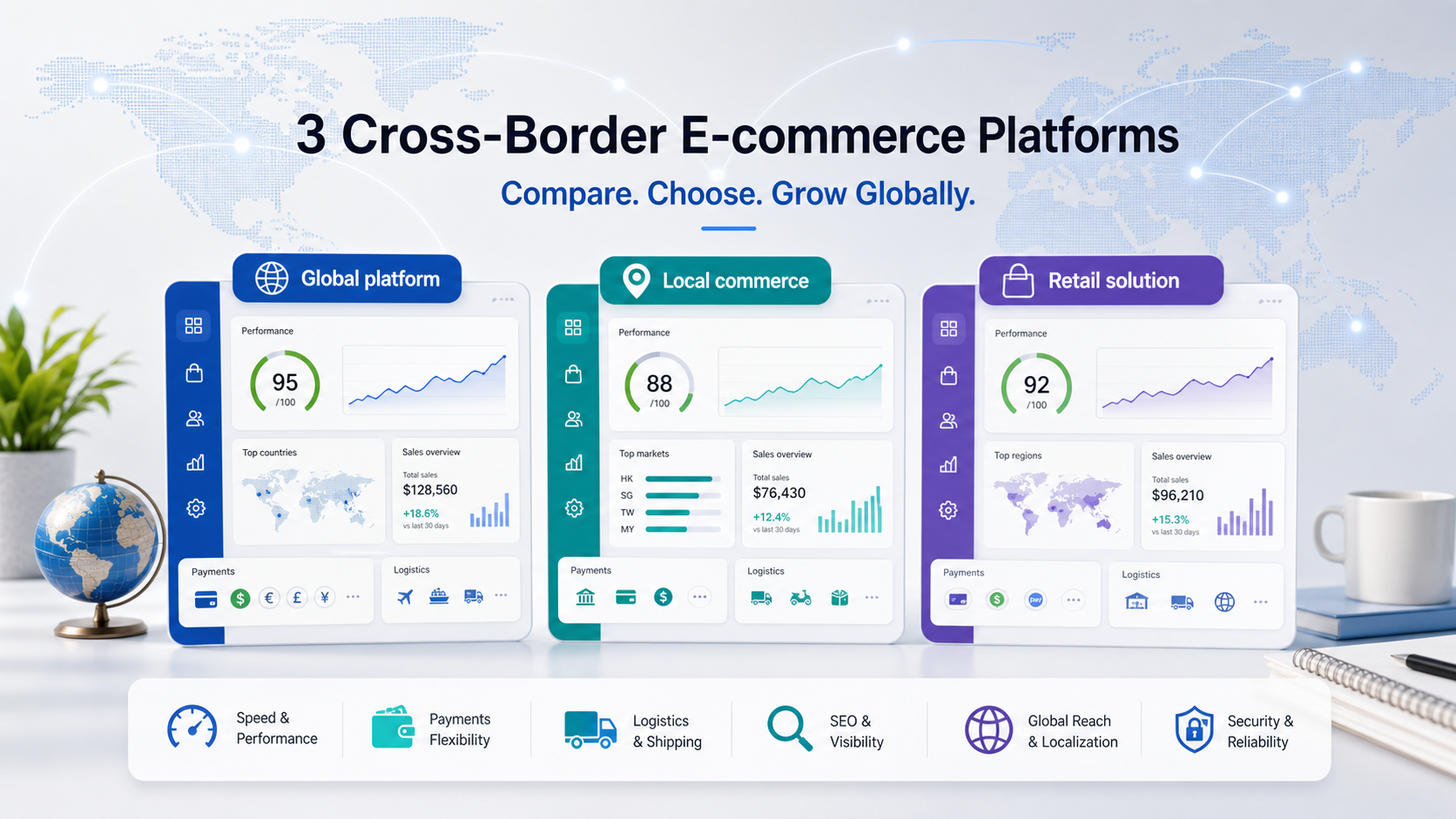
For merchants planning to build an independent e-commerce website, choosing the right platform is often more important than it may seem at first. The platform does not only affect how quickly a website can be launched. It also influences payment collection, logistics integration, marketing tools, SEO performance, scalability, and the browsing experience of overseas users.
Among Chinese-speaking e-commerce merchants, Shopify, 91APP, and SHOPLINE are all common choices. However, they have different positioning, different strengths, and different suitable use cases. This article compares them from several practical angles, especially website speed, server infrastructure, localization support, and long-term service capabilities.
1. Platform Positioning
Shopify is one of the most widely used e-commerce website platforms in the world. Its main advantages are a mature ecosystem, rich third-party apps, strong internationalization capabilities, and broad support for cross-border selling. It is especially suitable for merchants who want to sell to multiple countries or regions.
91APP is more focused on local brand e-commerce and new retail scenarios in Taiwan. It emphasizes the integration of official websites, membership systems, mobile apps, and offline stores. If a merchant already operates physical stores or pays strong attention to membership operations and O2O business, 91APP may better match those needs.
SHOPLINE mainly serves merchants in Asia and Chinese-speaking markets. It provides a relatively low entry barrier and a complete set of tools for store building, payment, logistics, and marketing. For merchants who want to quickly launch a Chinese-language e-commerce website, SHOPLINE is a common and practical option.
2. Ease of Use
All three platforms try to reduce the difficulty of building an online store. In most cases, merchants do not need to develop the website from scratch.
Shopify has a mature admin system and theme editing experience. It offers many templates and apps, making it suitable for merchants who want to control their store design and extend functions over time.
SHOPLINE also provides visual editing tools and is suitable for quickly launching an online store. 91APP is more solution-oriented, and its services are usually planned around official websites, mobile apps, membership systems, and offline retail integration.
If we only look at self-service flexibility, Shopify usually has an advantage. If a merchant wants the service provider to take a more active role in setup and implementation, SHOPLINE and 91APP may feel more familiar and localized.
3. Cost and Pricing Model
Shopify has relatively clear pricing tiers. Merchants can choose different plans according to their business stage. Its advantage is transparent pricing and a clear entry point. However, if a store uses many paid apps, the total monthly cost may increase.
SHOPLINE’s pricing usually depends on the selected plan and required features. Compared with a purely self-service platform, some advanced features may require additional fees.
91APP often uses a more consultative quotation model. Merchants usually need to contact its sales or service team to confirm the final cost. For medium and large brands, this model may provide a more complete service package. For small merchants, however, the budget may be less straightforward at the beginning.
4. Payment and Logistics Support
In terms of payment, all three platforms can support common online payment methods. Shopify is strong in international payments and is more suitable for cross-border e-commerce. SHOPLINE and 91APP are often more aligned with local payment habits in Taiwan and Asian markets.
In terms of logistics, SHOPLINE and 91APP generally provide better support for local delivery methods, convenience store pickup, and home delivery scenarios in their target markets. Shopify is designed for a global market, so logistics support often relies on its app ecosystem, third-party services, or local integration partners.
Therefore, if the target market is mainly Taiwan or other Chinese-speaking markets, localized platforms may be more convenient. If the target market includes Europe, North America, Southeast Asia, or multiple countries, Shopify’s international ecosystem may be more attractive.
5. Server Speed, Infrastructure, and Real-World Testing
Website speed directly affects user experience, advertising conversion, and SEO performance. A slow website may cause users to leave before they even see the product page. For cross-border e-commerce, the problem becomes even more obvious because visitors may come from different countries and network environments.
Shopify’s advantage lies in its global infrastructure and CDN support. Although its core infrastructure is not necessarily located in Asia, its global content delivery network usually allows users in different regions to access Shopify stores with relatively stable performance. For cross-border merchants targeting multiple countries, this is an important advantage.
SHOPLINE and 91APP also rely on mature cloud infrastructure, such as AWS, Google Cloud, Microsoft Azure, or similar cloud service providers. Their performance is usually acceptable in local or regional Asian markets, especially when the main customer base is concentrated in Taiwan, Hong Kong, Singapore, or nearby regions.
However, merchants should not judge platform speed only by official descriptions. A more practical approach is to test real website access speed from different locations. For example, merchants can use AccessTest to compare page loading performance from multiple regions and check whether a store is fast enough for target customers.
AccessTest provides online website accessibility and speed testing tools that can help merchants evaluate cross-border access performance. Instead of only testing from the merchant’s own office or home network, merchants can test from different nodes and compare response time, availability, and stability. This is especially useful when comparing Shopify, SHOPLINE, 91APP, or other independent website platforms.
For example, before choosing a platform, a merchant can prepare several reference websites built with Shopify, SHOPLINE, and 91APP, then test them with AccessTest:
- Test the homepage and product page URL of each platform.
- Compare access speed from target regions, such as Singapore, the United States, Europe, or other key markets.
- Check whether the response time is stable across multiple tests.
- Observe whether some regions are significantly slower than others.
- Use the results as one of the decision-making references before committing to a platform.
You can try the website testing tool here:
If the main target market is global or includes Europe and North America, Shopify’s global CDN and ecosystem may be more attractive. If the main customers are in Taiwan, Hong Kong, or nearby Asian markets, SHOPLINE and 91APP may also provide a good user experience. The key is to verify performance with actual tests instead of relying only on platform claims.
6. Customer Support and Localization
Shopify has a mature support system and a large global community. However, Chinese-language support may still be limited in some scenarios. Many technical problems may eventually require merchants to read English documentation, search community discussions, or work with third-party service providers.
SHOPLINE and 91APP are usually more friendly to Chinese-speaking merchants. They tend to provide stronger local support in areas such as customer service, payment integration, logistics setup, and business communication. For merchants who are not comfortable using English admin interfaces or solving technical issues independently, localized service can be a major advantage.
Therefore, merchants with stronger technical capability and a desire for more system control may prefer Shopify. Merchants who rely more on service support and local business guidance may find SHOPLINE or 91APP more convenient.
7. Customization and Scalability
One of Shopify’s biggest strengths is its app ecosystem. It has a large number of third-party apps covering membership, reviews, marketing automation, email marketing, customer service, finance, inventory, SEO, and many other functions. For merchants with long-term operation plans, Shopify offers strong room for expansion.
SHOPLINE also has its own app market, but its ecosystem is generally smaller than Shopify’s. 91APP is more focused on providing an integrated solution through its own platform and service team. This is suitable for standardized brand e-commerce and membership operations, but the freedom of extension may be more limited.
If a merchant wants to continuously test new tools, integrate overseas marketing services, or build a more flexible international e-commerce system, Shopify is usually the better choice. If the business model is relatively stable and the merchant values implementation service and operational stability, a localized platform may also be sufficient.
8. SEO and Marketing Capabilities
SEO is important for independent websites, especially cross-border e-commerce websites. If a platform supports flexible page titles, meta descriptions, URL structures, sitemaps, structured data, and blog content, it will be easier to build long-term organic traffic.
Shopify has mature SEO settings and many third-party SEO apps. It is suitable for merchants who plan to invest in content marketing and Google organic traffic over the long term.
SHOPLINE and 91APP also provide basic SEO features, but they are usually less flexible than Shopify in terms of ecosystem tools and advanced optimization. If a merchant mainly relies on paid ads, social media, influencers, or private traffic, the difference may be less obvious. But if Google SEO is a core strategy, Shopify may have a stronger advantage.
9. How to Choose?
If your main goal is cross-border e-commerce and you want to sell to Europe, North America, Southeast Asia, or multiple countries, Shopify is usually worth considering first. It is strong in international payments, app ecosystem, SEO, global infrastructure, and long-term scalability.
If your main business is in Taiwan or Chinese-speaking markets, and you want stronger local support for payment, logistics, customer service, and store operations, SHOPLINE may be a practical choice.
If you are a medium or large brand with offline stores, membership systems, and mobile app operation needs, and you want to integrate your official website, app, stores, and member data, 91APP may better fit this scenario.
In simple terms, Shopify is more like a global e-commerce infrastructure, SHOPLINE is more like a fast store-building platform for Chinese-speaking and Asian merchants, and 91APP is more like a brand new retail solution.
The final decision should not be based only on monthly fees or setup difficulty. Merchants should also consider target markets, website speed, payment methods, logistics support, SEO plans, team capability, customer support, and future scalability.
For cross-border merchants, platform migration can be costly. Before making a final decision, it is worth testing several reference websites, comparing their real access speed with tools such as AccessTest, and choosing a platform based on the business direction for the next one to three years.